
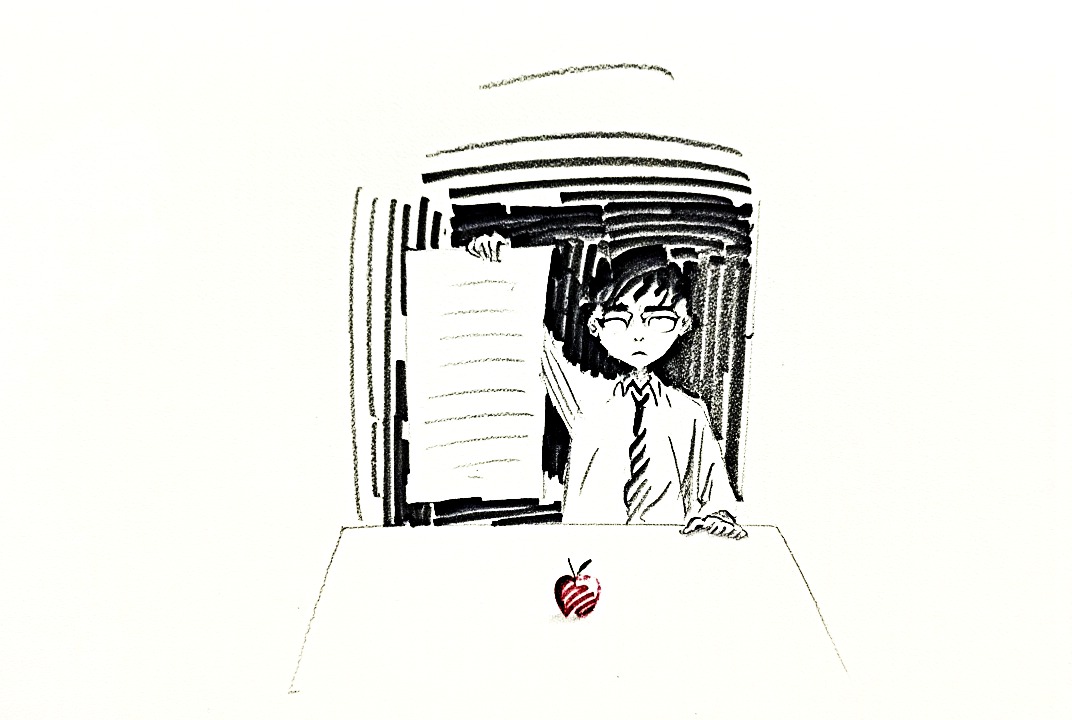
They opened the classroom door twenty minutes late. Giorgi let Eka go in first. She flashed an awkward smile at the faces turned toward them and walked inside with bent posture and slow steps. Giorgi followed right behind and stepped forward, hand already extended.
“Crazy traffic, I’m so sorry! Hope we didn’t keep you waiting too long.”
“Not at all… we’ve just gathered ourselves, actually, only a little while ago.” The tall, well-built man, who Eka assumed must be the school principal, shook Giorgi’s hand firmly with a wide smile. Then he sat down and gestured toward the two empty desks directly opposite him.
The desks were spread apart and arranged in a circle. About ten to fifteen people sat around; everyone could see each other’s faces. Eka and Giorgi slid into the chairs, awkwardly tucking their legs beneath the desks. Eka set her cup of coffee in front of her, popped off the lid, and lifted her hand toward her mouth to stifle a yawn.
“I wouldn’t trouble you on a Saturday morning like this,” the principal said, twirling a red pen in both hands, “but we didn’t want to make a decision without you.”
Giorgi nodded, as in “no problem at all”, and leaned back against the little chair’s backrest.
Eka opened her notebook and let her gaze circle the room. She didn’t know any of these people. A year ago, when the school had asked the consultants for help in improving teaching quality, she hadn’t yet been part of the team. Still, she had carefully read through nearly all the documents the earlier consultants had produced after working meetings and discussions.
The most important among them was a policy, dozens of points long, designed to improve teaching and learning quality. Its central idea was that students should grow fond of learning, cultivate curiosity, and gain motivation to study. Every clause, in one way or another, carried that spirit in its subtext.
One section, which Eka had written down in her notebook, stood out in particular: teacher selection—what kind of human values a teacher should possess, their ability to nurture a healthy relationships with students, tolerance toward them, and the capacity to make them interested, engage them in the learning process.
Still, she wasn’t fully convinced that such idealistic principles were truly practiced. Seeing this special school with her own eyes was the only way to know.
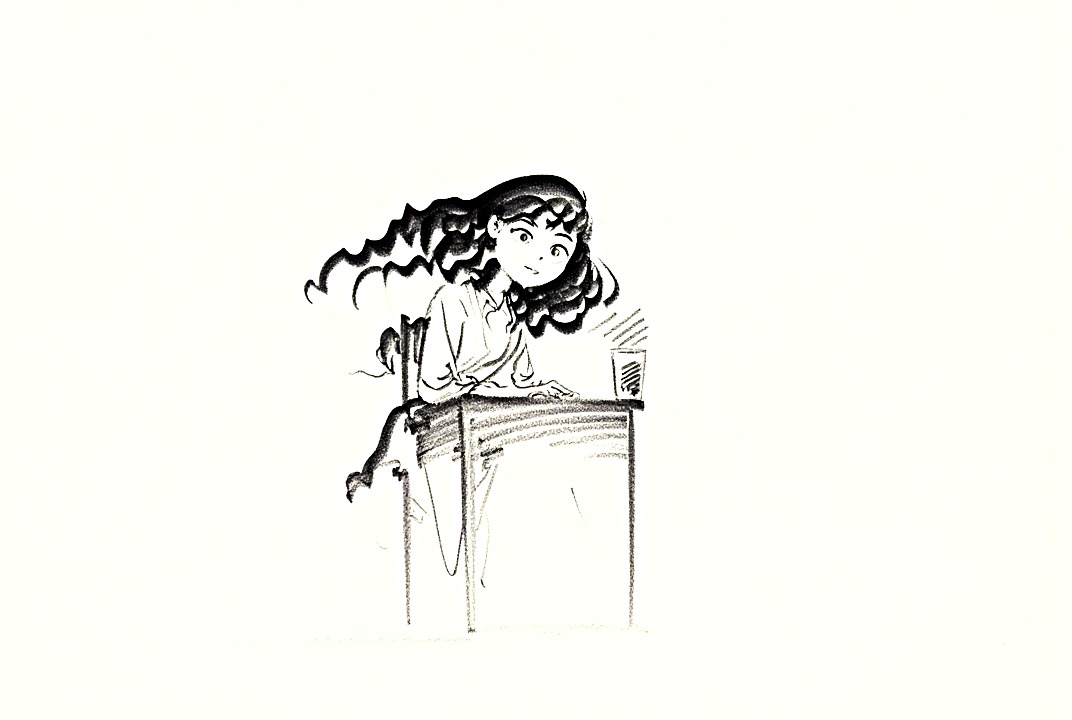
“So, here’s the situation,” the principal began. “One of our students, during a biology test, was punished by the teacher for making noise. She said he wouldn’t settle down, kept disturbing everyone, kept asking questions… as it goes. He wanted to cheat, apparently. The kid’s always restless, always messing around, with everyone. So, the teacher pulled his desk out, right in the middle of the test, and made him sit up front, apart from the rest. And on top of that, she told the whole class out loud that if Sandro kept this up, he’d never achieve anything in life. Said no one would want to be friends with him either, if all he did was being a freeloader…” The principal raised his eyebrows as he finished, as if to say: that’s how it is.
Not a great start.
“The class went quiet, no one said anything… He’s a thirteen-year-old boy. His mother says he came home humiliated, wouldn’t speak a word… and now she’s demanding we do something about this teacher. A warning, maybe dismissal. The boy himself says he won’t come back to school until something’s done.” The principal shrugged heavily and put down his pen. “So tell me—what do we do with this kid’s motivation?”
“And what does the teacher say? How does she explain herself?” Giorgi asked, raising his voice slightly to cut through the low murmurs spreading around the circle.
The principal tapped the table lightly with his hand and frowned. The whispering stopped instantly.
“The teacher, believe it or not, doesn’t think she did anything wrong. Says Sandro always disrupts class, never listens. Keeps everyone else from learning. So she had to do something to shut him up. Well, she shut him up all right—the boy’s practically shut himself out of school now.” The principal chuckled.
Giorgi rubbed his chin thoughtfully.
“Tornike, did you speak with the teacher?” He turned to the young man sitting at the principal’s right.
Tornike immediately straightened.
“Yes… Yes, of course,” he cleared his throat, speaking with caution. “I think this act clearly contradicts the policy we drafted last year. No question about it. She stripped the boy of his motivation to learn. That’s the result. And all our methods, our approach, the curriculum itself—they’re oriented toward one thing: making children love learning. According to policy, the subject departments meet weekly to discuss challenges, try new approaches. I personally oversee those meetings, and everyone’s involved. Ms. Nana could have brought up Sandro’s case there, and we would have solved it together. Maybe through a model lesson, or something. But telling a student, you’ll never achieve anything—that can follow him his whole life…”
Eka’s only thought was: why isn’t this teacher present at the very meeting where her case was being discussed?
“Hm…” Giorgi turned deliberately left. “And what does the department head think?”
The woman he addressed had both hands wrapped around her phone, eyes fixed on the screen. She suddenly lifted her head, slid off her glasses, and set the phone down. Eka saw no trace of agitation on her face; her pale eyes looked almost petrified.
“I’ve already stated my position and I’ll repeat it: I don’t support blaming the teacher. Nana is a very strong teacher, a true professional, a university professor… She knows how to do her job excellently. That boy has problems with other teachers too, and no one has managed to restrain him. He constantly breaks rules, disrupts others. Why should a kid like that be justified—one who’s no good himself and won’t let others learn either? A rotten apple, exactly!”
A murmur of alarm rose from three sides of the circle. Only the side aligned with the department head remained silent.
“No one here is defending only the child here!” cried the woman sitting to the principal’s left. Her jet-black hair was pulled tightly back, her long black nails and flashing eyes seemed ready for battle. “We’ve spoken to Nana many times, given her guidance. Tornike himself has explained over and over how she should deal with students, how to manage the class. But some people think they’re the smartest ones in the room, that no one can teach them anything.” Her face twisted with scorn. “And as for Sandro—he was my student in primary. Mischievous, yes, but what he needs is a tailored approach. Rotten he is not!”
“Well, you can tell whose student he was… indeed,” the department head muttered with a smile, slipping her glasses back on and reclaiming her phone.
“Excuse me?!” The black-haired woman flared up even more. The principal gently placed a hand on her shoulder and shook his head.
Three seats down from the department head, a younger woman cautiously leaned forward to address the room:
“Many parents adore Ms. Nana. I know for a fact that several enrolled their kids here just because of her, so that later they’d get into medicine school…”
Eka’s eyes widened. She shook her head faintly and took a sip of coffee. She remembered her own classmate, the chemistry teacher always gave her top marks, though the girl hadn’t even known the symbol for hydrogen.
“What’s the boy’s academic record like?” Giorgi asked, once the murmurs calmed a little.
The principal looked to Tornike for the answer.
“He’s the best in math. Strong in English too. Almost all subjects, his grades are high”, Tornike cleared his throat, “except biology…”
A smile flickered across Giorgi’s face as he nodded. Then he glanced at the principal. Eka instinctively followed. The principal, serious-faced, was staring at the sheet of paper resting on the notebook before him.
“As I recall,” Giorgi lifted his brows, speaking carefully, “the policy clearly lists the grounds for a teacher’s potential dismissal. Teachers whose students consistently underperform, and who make no effort to improve outcomes. Teachers who can’t manage their classes, or who mistreat their students…”
The department head gave a mocking smile.
“Excuse me, but this school existed long before that policy. With all respect, outsiders can’t dictate who should be dismissed.”
Eka instantly caught the glances of teachers sitting along that woman’s side—eyes fixed on the department head as though she were their savior, their leader. She turned to Giorgi, tense, waiting for his response.
Giorgi cleared his throat, cracked his knuckles.
“Ms. Inga, perhaps you weren’t present at the working meetings, but I missed none of them. I remember well—every teacher and manager involved voiced their opinions openly. It took many sessions and many revisions to finalize that document. If this policy holds no weight, then we must admit we wasted everyone’s time.”
The department head shook her head in disdain, returned to her phone, unwilling to argue further.
The principal lifted his eyes with a conflicted look, picked up the sheet of paper, and turned to Giorgi.
“There’s another thing… The policy also says that we don’t expel a child for poor academic performance. But if his behavior disrupts the class, if it prevents others from learning…” He spoke as if reciting the words directly from the page.
Eka remembered this part as well. Now the policy no longer leaned toward the child either.
Giorgi nodded, as if he understood, and after a pause, spoke:
“That’s a very important clause. But the policy also says that each case must be examined individually. If we expel a child simply because he misbehaves or struggles with focus, then half the school would be gone. More than half, maybe. You agreed back then that awakening the desire to learn was the school’s priority—and that means it must also be the teacher’s. For mischievous or difficult students, there are psychologists, behavioral strategies, countless methods to address it. Perhaps the teacher spoke without thinking. Or maybe she did mean it, maybe she thought it would silence him. The fact remains—it didn’t help the kid. That, I think, should be decisive.”
The principal frowned, nodded slowly.
“Let’s vote.” he said, looking around at his colleagues.
They voted. Only half the room sided with the teacher. The other half refrained from a firm stance.
The final word lay with the principal.
“By the way…” the department head peered over her glasses at him. “Nana’s been here since the days of Mr. Davit. From the very first day, from the school’s founding. Until now, there was never such a problem.”
Several people glanced with regret at the portrait hanging above the blackboard: a full-faced man with a kind smile gazed happily out, his features nearly identical to the principal’s, only older, silver-haired.
The principal rolled his eyes at Giorgi, then smiled. He straightened in his chair, spreading his shoulders—towering over everyone else.
“I believe the most important thing is making children love learning. Creating a healthy environment. Students should be glad to come here! This isn’t just philosophy, it’s our school’s principle—the very principle Davit built into it!” He gestured toward the portrait. “A teacher must first be a human being, and then a professional. The teacher must manage a class in such a way that students don’t lose their desire to come to school. If we encourage manipulative punishments and humiliations, teachers will never learn to manage a class properly, nor to handle difficult children. And then we’ll be failing the students and their futures altogether. So this must not happen again. Not under any circumstances!” He set the paper firmly on the table and pressed his hand down upon it.
An uproar broke out. Voices rose again, more heated than before.
The department head sat back with arms crossed, leaning into her chair, her eyes hidden behind her glasses.
Eka gulped down the last of her cold coffee.
On the principal’s left, the black-haired woman wore the satisfied smile of victory.
This wasn’t going to end here.
Helping Organizations to unlock their purpose, agree on the strategy and align their structure according to this.